
Hostería Chukirawa es uno de los primeros sitios de alojamiento autorizados por el Ministerio de Turismo en Quilotoa. Desde 2008


Most travelers come to Quilotoa Ecuador for the lake. They leave with something different: the feeling of having touched, even briefly, a way of life that has been building itself at 3,914 meters above sea level for centuries.
This blog is not about the lake. It’s about everything that surrounds it.
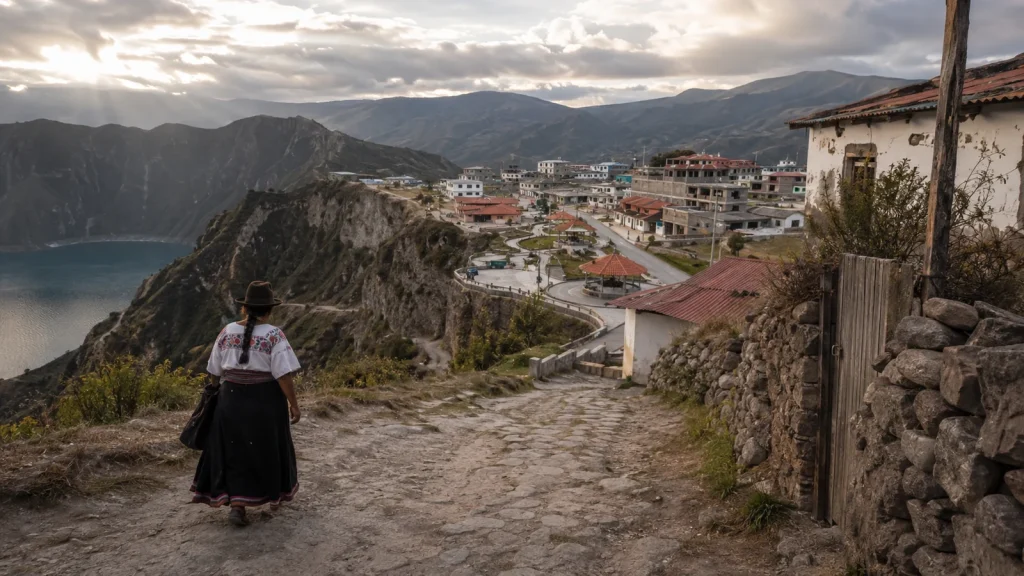
Before you see the lake, it’s worth knowing what its name holds.
Quilotoa comes from two Kichwa words: Kiru, meaning tooth, and Toa, meaning princess. The volcano’s name can be read as “the princess’s tooth” — an image that makes sense when you see the elliptical shape of the crater from the rim: a perfect curve that opens over the Andean landscape like a mouth into the interior of the earth.
Another interpretation says Quilotoa means “Lagoon of the Princess”, in honor of Toa, a Shyri princess — one of the peoples who inhabited these territories before the Inca expansion and long before the Spanish conquest.
Two stories, one name. In the Andes, language always has layers.
The Quilotoa volcano belongs to the Ilinizas Ecological Reserve, in the province of Cotopaxi, 66 km south of Latacunga. Over the last 200,000 years it has had approximately eight major eruptions. The caldera where the lake now sits formed 800 years ago — what you see when you lean over the rim has 800 years of geological history, and on its edges, communities that have been building their own for just as long.
Arriving in the village of Quilotoa and looking at its buildings is like reading a manual on adapting to your environment. Here, nothing is built to impress — it’s built to survive the cold, the wind and the altitude.
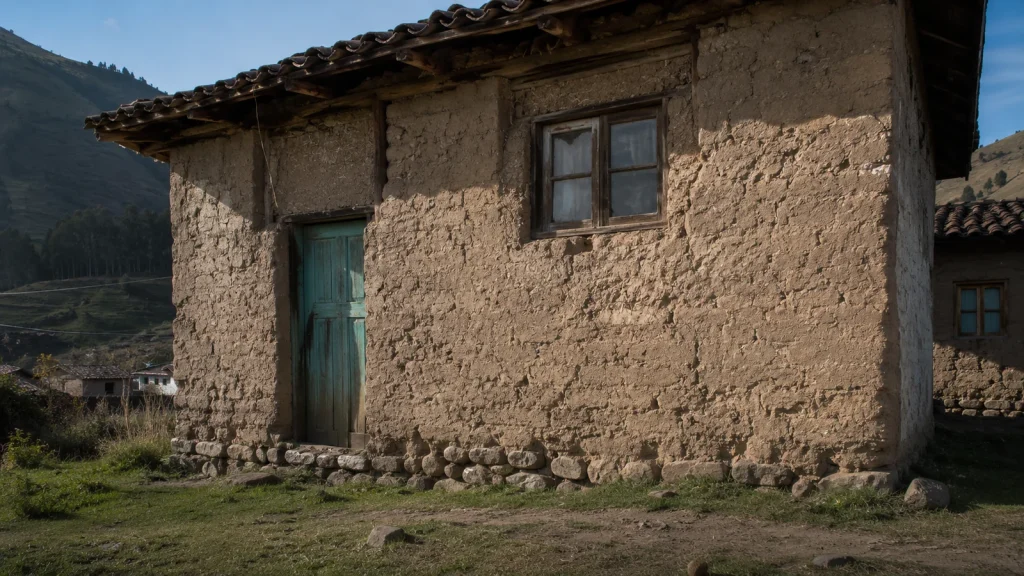
The architecture of the area is vernacular: it uses ancestral knowledge and local materials. The buildings of Quilotoa and the surrounding communities are built primarily in adobe — raw earth blocks mixed with straw — an ancient technique that responds perfectly to the cold high-altitude climate, with temperatures ranging between 6°C and 12°C and nights that can approach 0°C.
Adobe has a property no modern material can replicate in these climates: it stores heat during the day and releases it slowly through the night. The thick walls of Kichwa homes are not an aesthetic accident. They are centuries of adaptive engineering.
The ancestors of the communities that inhabit Quilotoa today — the Panzaleo — identified settlement patterns in Andean architecture that responded to ecological adaptation and to the Andean worldview, deeply respectful of the Pachamama.
Near the crater, this constructive tradition has a remarkable contemporary expression: the Chaki Wasi crafts center of the Shalalá community — whose name in Kichwa means “straw house built from the ground to the roof”. Built with river stones as a base, eucalyptus wood structure joined with cabuya (fiber from the penco plant) and wrapped in a large straw mantle, the entire structure was raised by hand with simple tools and the collective strength of the community.
Architecture that doesn’t need architects. It needs community.
The communities of Quilotoa are descendants of the Panzaleo, one of the oldest peoples of the Ecuadorian highlands. They absorbed first the Inca expansion and then the Spanish conquest, but kept their language — Kichwa — and their relationship with the land. Today their descendants farm the same hillsides their grandparents farmed, at the same altitudes, with many of the same seeds.
Their mother tongue is Kichwa, though they also speak Spanish today. At the Zumbahua market — held every Saturday and one of the most authentic in all of Cotopaxi province — you still hear more Kichwa than Spanish among the stalls of fruit, tubers and textiles.
One of the most recognizable cultural expressions of the area is the art of Tigua. A few kilometers from the crater, this community produces paintings on dried sheepskin — vivid and colorful, representing the land, the volcanoes, the sacred animals and the customs of the people who live in the Quilotoa region. Art born in the 1970s that today sells in galleries around the world.
The food of Quilotoa is not designed for tourists. It is designed for people who work the land at altitude and need real calories and warmth from the inside. That makes it, paradoxically, one of the most authentic gastronomic experiences in Ecuador.
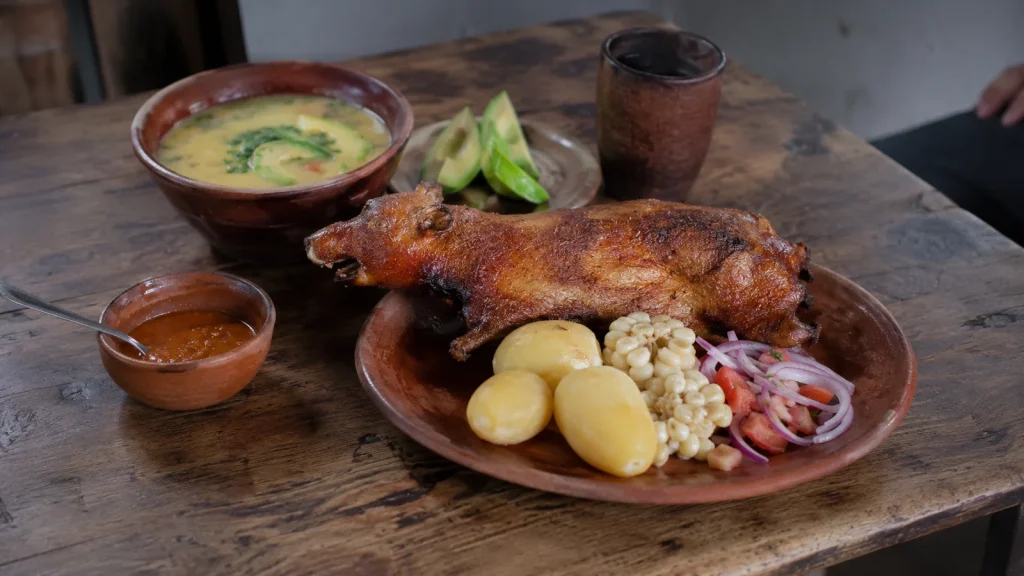
The most iconic dish of Cotopaxi’s Andean gastronomy. The cuy is roasted over charcoal or wood fire, seasoned with garlic, cumin, achiote and local herbs, and served with potatoes, hominy, chili and fresh salad. For many international travelers it’s their first encounter with cuy — and it almost always surprises. Guinea pig has been part of the Andean diet for more than 5,000 years and is considered a symbol of Kichwa culture associated with purification and good fortune. Not just food: history on a plate.
A creamy potato soup with cheese, avocado and toasted corn. At 3,914 meters with the páramo wind outside, a hot locro is exactly what the body asks for. It’s the oldest dish in Andean gastronomy and the most universal — naturally vegetarian, comforting no matter where you come from.
The most intense dish on the local menu. A potato soup with lamb offal — liver, heart and tripe — seasoned with creole spices, pickled onion and chili. Its name in Kichwa literally means “blood locro”. Strong flavor, high nutritional value and deep ancestral symbolism in Andean culture.
Llapingachos are cheese-filled potato cakes, pan-fried golden, served with peanut sauce and avocado. Grilled trout — farmed in the high-altitude rivers and lakes of the area — is the lightest option on the local menu and the favorite of travelers who prefer not to try the cuy.
The inevitable drink after a day of trekking in Quilotoa. Hot water with cinnamon, sugarcane spirit and raw cane sugar. At nearly 4,000 meters above sea level, canelazo is not an option — it’s a necessity.
What makes Quilotoa special is not just the lake. It’s that everything surrounding it — the name, the houses, the food, the language, the art — forms a coherent cultural system that has been resisting for centuries.
The Kichwa communities of the area have found in tourism a way to sustain that coherence: they sell their crafts directly, offer accommodation in their own buildings and guide travelers along trails their grandparents traced.
Hostería Chukirawa is part of that ecosystem. Located steps from the crater, in the heart of the Quilotoa village, it’s the place from which you can experience all of this up close — the lake at dawn, the trek along the volcano rim, locally sourced food prepared with ingredients from the area, and the chance to connect with the communities that make Quilotoa something more than a landscape.
📍 Reservations: quilotoa.ec
Hostería Chukirawa es uno de los primeros sitios de alojamiento autorizados por el Ministerio de Turismo en Quilotoa. Desde 2008


